


Blog
Hollywood Co-Stars: oneAPI and Open Source Technology
April 23, 2022




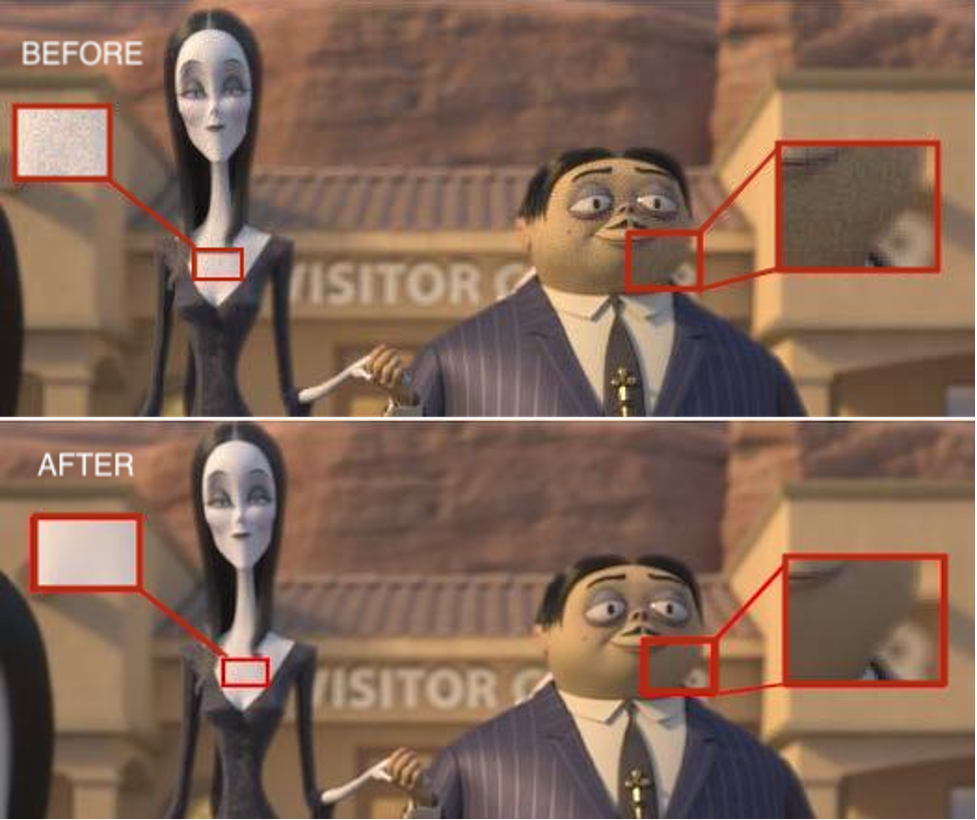
Intel Open Image Denoise is AI-based and runs on CPUs and GPUs. Prior generation, image filtering based denoisers often were slower and less accurate. AI denoising can occur nearly instantaneously with higher fidelity, enabling artists to fast-track the workload and accelerate production. “Without a high quality denoiser, it can take 8 to 24 hours to render one frame of a movie,” said Jeffers. “Open Image Denoise lets the computer artist choose how long they want to spend on render passes versus denoising, so they can get the right balance between image quality and rendering time, enabling more film refinement iterations to the director so the vision of the movie can be better met within budget” he added.
How Hollywood Professionals, Intel and Autodesk Worked Together
Cinesite, the company that created The Addams Family 2, was using Arnold, a popular render software made by Autodesk, for special effects and animation, along with Gaffer, an open-source, node-based VFX application used to build, modify and render scenes.
Arnold, which has its own denoise functionality, had not incorporated Intel Open Image Denoise. However, the filmmakers wanted to use the Intel product on Arnold, due to its ability to produce more brilliant, vivid images that supported the look and feel of the film. To make that possible, Intel worked with Autodesk to integrate Intel Open Image Denoise into Arnold. This allowed The Addams Family 2 to be rendered and denoised in record time, without sacrificing quality or spending an inordinate amount in computer processing.
The Addams Family 2 Co-director, Laura Brousseau, and Head of Lighting and Composition, Kenny Chang, explain about how they used Intel oneAPI libraries and other tools at Cinesite to render and denoise the images in The Addams Family 2. According to Chang, they used Intel Open Image Denoise on every shot in the movie, delivering a 10-25% increase in rendering efficiency. “We saved thousands of hours in rendering production,” said Chang.
 The creepy and kooky come to life in The Addams Family 2 with brilliant imagery and photorealism powered by Intel® Xeon® processors and multiple rendering tools including Gaffer, Autodesk Arnold, and Intel® Open Image Denoise.
With its machine-learning algorithms and efficient deep-learning-based denoising filters, Intel Open Image Denoise removed noise from the images in The Addams Family 2. Through machine learning training, it learned to differentiate the good (geometric shapes, textural detail and patterns) from the bad (render and pixel noise) and remove the latter.
The Intel Open Image Denoise process produced brilliant scenes, while significantly reducing the rendering time on every shot. At an average of 175 shots per week, run in parallel and 24/7 on the render farm, machine-power time was reduced by more than 500 hours per week throughout the production.
The Market’s Never Wrong, and Hollywood is a Marketplace
The idea that Hollywood studios would cooperate around open source code and standards comes down to business sense. The Academy of Motion Picture Arts and Sciences (AMPAS) – the same organization behind the Oscars® – conducted a two-year survey into the use of open source software across the motion picture industry.
Nearly 84% of the industry uses open source software the survey showed, predominantly for animation and visual effects, but it also uncovered challenges. These included siloed development, managing multiple versions of open source libraries and varying governance and licensing models that must be overcome to create a vigorous open source community.
The survey led to AMPAS forming the Academy Software Foundation (ASWF) to help overcome obstacles to production around open source software. Since then, the ASWF has built a solid community and a set of projects that align with its mission of increasing the quality and quantity of contributions to the industry’s open source software base, while providing a:
- Neutral forum to coordinate cross-project efforts
- Common build and test infrastructure
- Clear path to participation in advancing our open source ecosystem
 The Academy Software Foundation show reel demonstrates how the open source movement has transformed movie making, enabling studios to produce more exciting animation and special effects with fewer resources.
A Real Hollywood Ending
In the early days of the motion picture industry, technology played a major role. Today, perhaps, even more so. The greatest change between the birth of Hollywood and the present may be how studios and organizations now work together.
By committing themselves to open source software, Hollywood producers can increase their investment in the artistic side of movie making. In this way, they’re reducing costs and enabling the telling of new stories in ways that were once technically and economically impossible.
Get Involved and Review the oneAPI Specification
Learn about the latest oneAPI updates, industry initiative and news. Check out our videos and podcasts. Visit our GitHub repo – review the spec and give feedback or join the conversation happening now on our Discord channel. Then get inspired, network with peers and participate in oneAPI events.
Legal Disclosures
- Testing Date: Results are based on data conducted by Cinesite 2020-21.
- 10% to up to 25% rendering efficiency/thousands of hours saved in rendering production time/15 hrs per frame per shot to 12-13 hrs.
- Cinesite Configuration: 18-core Intel® Xeon® Scalable processors (W-2295) used in render farm, 2nd gen Intel Xeon processor-based workstations (W-2135 and -2195) used. Rendering tools: Gaffer, Arnold, along with optimizations by Intel® Open Image Denoise.
- Performance varies by use, configuration, and other factors. Learn more at www.Intel.com/PerformanceIndex.
- Your costs and results may vary.
- Intel technologies may require enabled hardware, software, or service activation.
- Intel does not control or audit third-party data. You should consult other sources to evaluate accuracy.
© 2022 Intel Corporation. Intel, the Intel logo, and other Intel marks are trademarks of Intel Corporation or its subsidiaries. Other names and brands may be claimed as the property of others.